War and Competencies
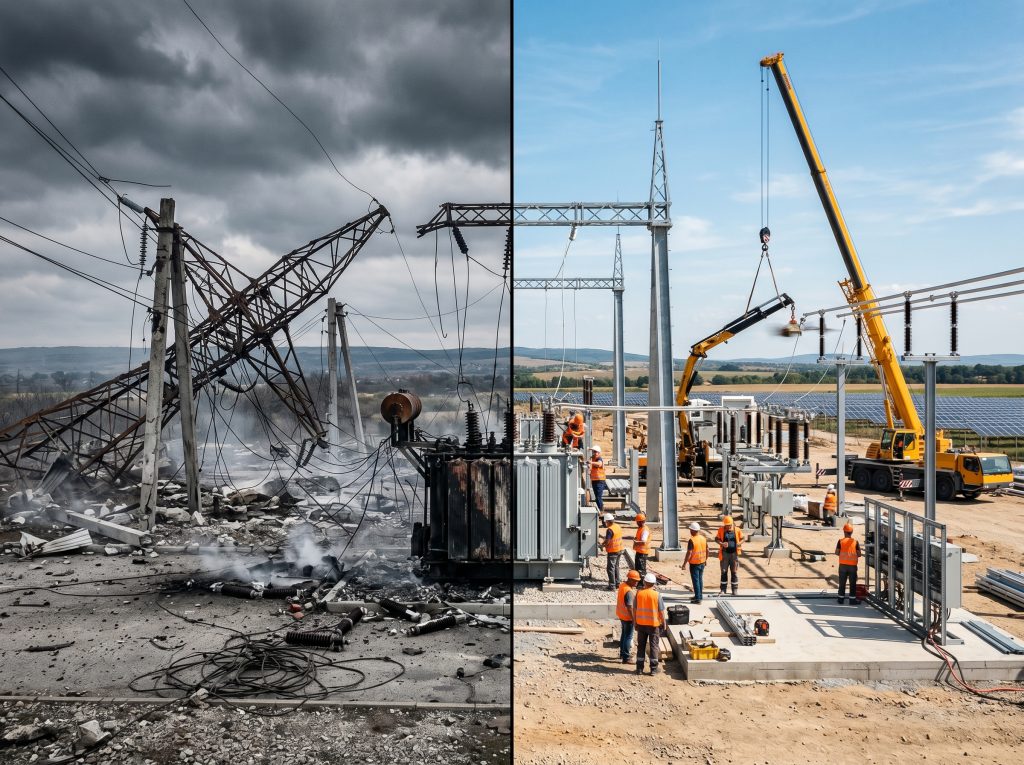
The launch of the full-scale invasion in February 2022 marked a turning point that established a fundamentally new context for project management in Ukraine. Industrial enterprises and project teams now operate under wartime conditions, with a significant share of them working within critical proximity to the active front line. Major industrial projects have entered a phase of crisis, which in certain cases has brought delivery to a halt in the East and North of the country. Strategic energy assets have suffered numerous attacks and severe damage. Recovery requires a balanced strategy and a substantial acceleration in project delivery.
Steering projects out of crisis demands a fundamentally different set of competencies from project managers. Once a project enters a stage of systemic failure, the standard PM toolkit ceases to work. What is needed is the ability to rapidly diagnose the root cause, make decisions under acute time and information constraints, and restore manageability without halting project execution.
This means that, alongside standard methodologies, strong project leaders must possess a distinct set of competencies: the ability to read early signals of degradation, to switch from planning mode into stabilization mode, and to keep the team within a manageable state even when external circumstances move beyond the scope of any plan. These competencies were not taught in classical programs. Today, a new chapter is being written in the institutional memory of project management — and our experience is becoming a uniquely valuable asset.
Reconstruction
The expert community is unanimous: the management of reconstruction, modernization, and critical infrastructure projects will become the principal driver for industrial projects. According to the updated RDNA5 assessment, Ukraine’s recovery and reconstruction needs over the next decade amount to nearly USD 588 billion — with energy, transport, and housing among the most affected sectors.
This generates enormous demand for project managers capable of working not only at the technical level — with schedules and budgets — but also at the institutional level: with investors, donors, supply chains, ESG requirements, public reporting, and the specific risks of project delivery in wartime conditions.
At the same time, a systemic gap is being recorded between the volume of declared funding and the actual pace of reconstruction project delivery. The conclusion is self-evident: the money is there — bankable projects are not. The market’s problem today is not a shortage of funding, including international funding. The problem is a shortage of projects prepared to international standards: with a high-quality feasibility study and a realistic potential for delivery. Insufficient project preparation and a mismatch with current investment standards constrain the Ukrainian economy’s access to external resources and delay genuine reconstruction projects.
From Strategy to Result Through Project Delivery. PMO
Large, complex industrial projects may have their own dedicated strategies or extend a company’s broader business portfolio. The classic problem: a strategy is written by consultants but ends up sitting on the shelf — because there is no team capable of delivering it. This problem is amplified by a shortage of qualified managers with an industrial profile. The market is saturated with PMs from the IT sector, yet industrial projects demand a fundamentally different set of competencies.
Today, the capability of the team and the level of its competencies are becoming a decisive factor in investment decisions for effective investors. Project complexity has ceased to be the exception — it is the operational reality across most industries and regions. PMI research confirms it: traditional “best practices” are no longer sufficient. Complex projects are systems of non-linear dependencies, not collections of tasks. Their effective delivery requires systems thinking, not merely the execution of PMBoK processes.
Within organizations, the most effective institutional element of the management system is the PMO (Project Management Office). In successful systems, the role of the PMO is being redefined: from a team that prepares presentations to an entity that generates value.
We are convinced that the PMO must be a strategic partner to the business — an “engine of value creation, ” not an administrative unit for closing out issues. The real role of the PMO is to substantiate and shape the company’s portfolio, prioritize projects, contribute to the business model, manage risk, and proactively engage with stakeholders.
Over the coming years, the prospects of businesses and investment projects will be determined by the maturity of their project management systems and PMO functions — calibrated to this new context. What remains critical is the motivation and competencies of the specialists engaged in delivering industrial projects, especially those with genuine experience of operating within the new reality.
Ukraine is entering a phase in which the capital for reconstruction is gradually becoming available. What is becoming scarce is the capacity to convert strategies and investor interest into bankable industrial projects — and to take them through to results. This is precisely our zone of competence.
About POWERHOUSE
Powerhouse is a trusted strategic and operational partner for businesses, investors, and industrial projects. Our value lies in a unique combination: hands-on experience managing large industrial enterprises and complex projects, the analytical depth of leading consulting practices, and a proven project management methodology.