Transparency and traceability of information – the foundation of stakeholder trust
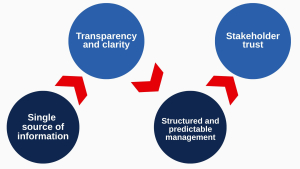
Stakeholder trust is one of the key success factors for any industrial project. Investors, government regulators, local communities, partners, and the project team must understand the actual status of the project and see the rationale behind decisions made, as well as the status of work execution, risks, and obligations. For this reason, transparency and traceability of information are no longer merely a marker of quality management – today, they are a prerequisite for securing financing, obtaining permits, maintaining stakeholder support, and ensuring the overall viability of the project.
These principles are reflected in the focus of international standards (ISO 26000, AA1000, IFC Performance Standards, IRMA, etc.) as well as international financial institutions and investors. They assess not only the technical and financial parameters of a project, but also the team’s ability to ensure transparent, structured, and clear information management. This is why modern industrial projects are increasingly adopting digital solutions that create a single source of information, enhance process transparency, and strengthen trust among all project stakeholders.
SRM systems for Complex industrial projects
Stakeholder Relationship Management (SRM) systems make it possible to shift interaction with communities, regulators, landowners, investors, and contractors from a “manual mode” into a managed digital process. They create a single database, make records of all communications, and help track agreements, complaints, land issues, and social commitments.
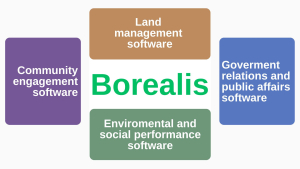
Based on Powerhouse’s experience, one of the effective products widely used in the market in this area is the software solution developed by the Canadian company Borealis. The company is our partner and provides a digital platform for managing stakeholder engagement in complex infrastructure and industrial projects, which is certified as compliant with international standards: GRI, IFC, IPIECA, and ICMM. The system centralizes stakeholder data, records the history of multichannel communication, enables real-time analysis of engagement, and provides a single source of information for various project teams. This approach makes it possible to identify problem areas more quickly, coordinate further actions, and make decisions based on up-to-date data rather than disparate spreadsheets and isolated reporting elements.
Successful implementation of the Borealis SRM system by foreign companies, including:
- CN – Canadian National Railway Company.
- Rio Tinto – one of the world’s largest mining companies, headquartered in London.
- Sherritt International – a Canadian resource company engaged in nickel and cobalt mining and refining.
- Sulawesi – a joint venture between Rio Tinto and Sherritt International for the development of nickel deposits in Indonesia.
- Repsol – the largest oil and gas company in Spain and Latin America. Case: management of its assets in the United States and Canada.
- Enel – a multinational renewable energy company headquartered in Rome, Italy. The project was implemented in Mexico for one of the companies within the Group.
- SMFG – a joint venture between High Power Exploration and the Government of Guinea managing the Nimba Mountains iron ore deposit. Collaboration on developing software to manage this deposit.
- Trans Mountain – a Canadian pipeline company transporting oil and petroleum products across several regions of Canada.
- Agnico Eagle – a Canadian gold mining company operating in Canada, Finland, Mexico, and Australia. Development of stakeholder management software for all countries where Agnico Eagle operates.
- Guinea Alumina Corporation – a Guinean subsidiary of Emirates Global Aluminium, one of the world’s largest aluminum producers.
- PanAust – an Australian mining company. Project: provision of software as part of the development of deposits in Myanmar.
- Feronia – a Congolese palm oil producer.
Based on Powerhouse’s experience, one of the effective products widely used in the market in this area is the software solution developed by the Canadian company Borealis. The company is our partner and provides a digital platform for managing stakeholder engagement in complex infrastructure and industrial projects, which is certified as compliant with international standards: GRI, IFC, IPIECA, and ICMM. The system centralizes stakeholder data, records the history of multichannel communication, enables real-time analysis of engagement, and provides a single source of information for various project teams. This approach makes it possible to identify problem areas more quickly, coordinate further actions, and make decisions based on up-to-date data rather than disparate spreadsheets and isolated reporting elements.
AI – a tool for the rapid enhancement of project management
Over the past few years, AI has established itself as a reliable tool in the day-to-day work of project teams, enabling them to automate routine analytics, generate status reports, prepare management reporting, organize project documentation, keep knowledge bases up to date, research potential risks, and help teams identify problem areas more quickly. These capabilities are critical for industrial projects, where large volumes of analytical information and reporting are compounded by a significant number of stakeholders and a highly dynamic environment.
At the same time, artificial intelligence is gradually becoming an effective tool that can increasingly be applied to the management of industrial projects. Here, its value lies not only in automating individual tasks, but also in its ability to strengthen key management processes: allocating tasks among team members, identifying and monitoring risks, preparing materials for discussions, generating ideas, tracking project implementation status, detecting deviations, and analyzing potential losses and benefits.
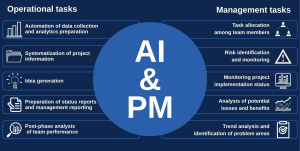
The greatest practical impact from AI implementation occurs when it is integrated into a well-structured project management system: one with clearly defined roles, up-to-date data, transparent processes, a single source of information, and regular monitoring of execution. In this format, AI does not replace management decisions but strengthens the team: it reduces workload, speeds up information processing, improves the quality of analysis, and helps respond in a timely manner to risks, deviations, and changes in the project environment.
Digital tools and AI create applied value in project implementation: they speed up work, strengthen analytics, make information more accessible, and accelerate management decision-making. At the same time, a systemic approach forms the foundation for this value: it structures processes, defines roles and responsibilities, ensures data quality, and establishes a single source of objective information. This is precisely why a successful combination of systemic management with well-chosen digital solutions delivers the most rapid transformational effect.