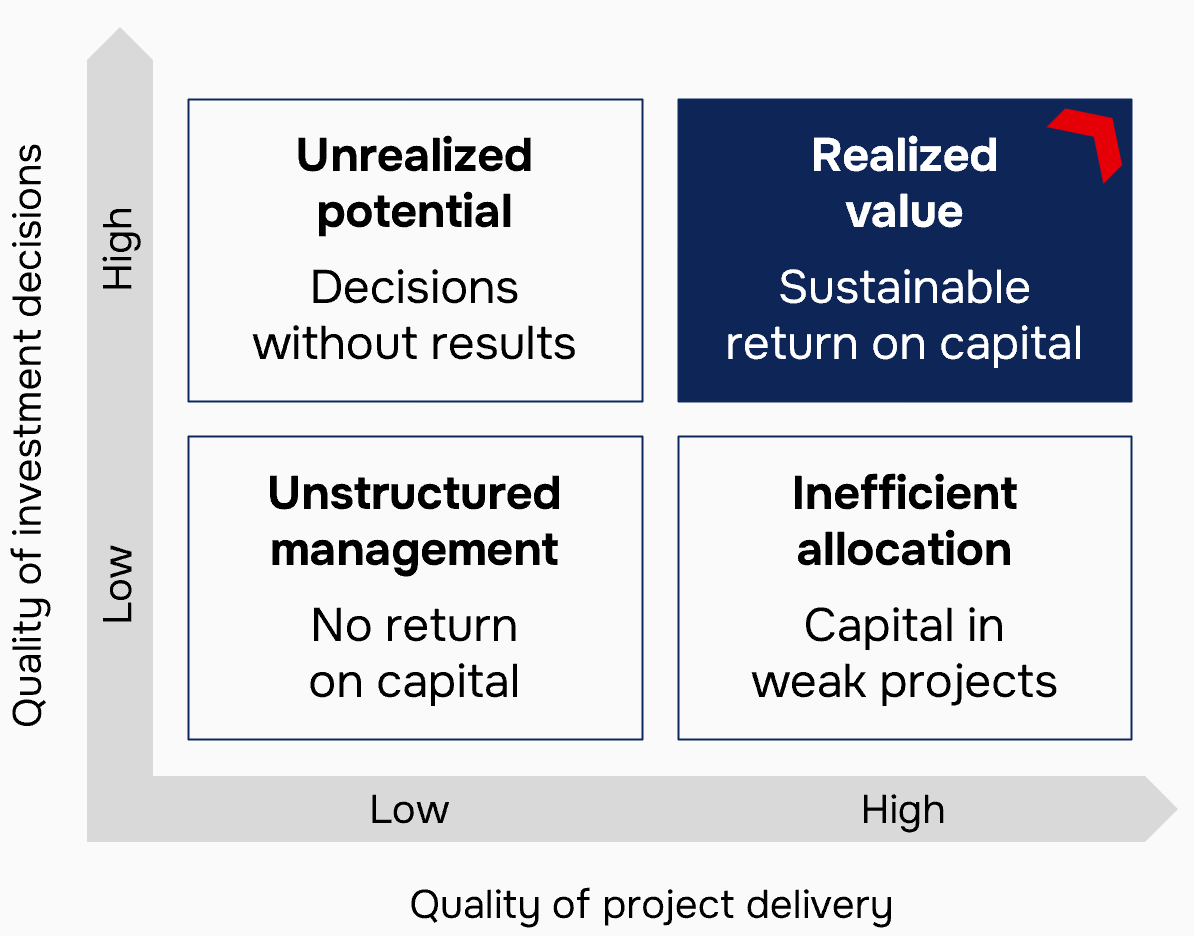
The number of investment initiatives within a company typically exceeds the capital available to fund them. To use this limited resource effectively, the investment process must address two objectives:
- Selecting the initiatives with the highest value;
- Delivering the selected projects to their planned results.
Each objective is owned by a separate system:
- The investment decision-making system (the investment function) ensures that selection is well-founded:
- analysis of initiatives against common criteria;
- financial and operational modeling;
- prioritization of competing projects within available capital;
- project and transaction structuring;
- risk assessment and mitigation.
- The PMO (project management office) ensures that selected projects reach their planned results:
- a single project management methodology and set of standards;
- delivery planning and control;
- risk and change management;
- stakeholder engagement;
- transparent reporting to owners and investors;
- oversight of the project’s alignment with its approved parameters.
The two systems are interdependent. The quality of selection determines the portfolio’s potential value; the quality of delivery determines the extent to which that value is captured. Return on invested capital is generated at both stages, so a sustainable outcome requires the two systems to operate in alignment.
Our team has successfully implemented investment management systems and PMOs at large energy and industrial enterprises: effective tools for analyzing, evaluating, prioritizing and selecting dozens of projects a year, as well as managing the delivery of investment portfolios exceeding $1 billion.
This experience is the foundation of what we offer businesses and investors at Powerhouse.