
Support for a Production Sharing Agreement (PSA) in an oil & gas project
-
300+
pages in final document package
-
3sites
covered by the production sharing agreement
-
2agreements
PSA and the agreement between investors (JOA)
-
~$130M
minimum investment commitments
Context
Initial state
A production sharing agreement (PSA) is a long-term contract between the state and an investor, under which the state grants the right to develop a field (for example, oil and gas field), while the investor funds the work at its own expense and at its own risk. In return, the investor receives a share of the produced resources on stable terms that remain unchanged throughout the life of the agreement, along with the incentives provided by law. Revenue from the produced resources first goes to compensate the investor’s costs, and the remainder (the profit) is split between the parties in pre-agreed proportions. In this case, an oil & gas company, together with a foreign co-investor, won a competitive tender for the right to enter into a production sharing agreement (PSA) covering three oil and gas fields. This created the need to promptly conclude the corresponding agreement with the state and to build out the entire contractual and accounting architecture of the future project.
The challenge was that the legislation defined the framework for such agreements only in general terms: most of the practical mechanisms (production sharing, reporting, cost accounting, interaction between investors) had to be worked out essentially from scratch. At the same time, the agreement had to fairly reflect the interests and rights of all parties — the state and both investors — while matching the specifics of operating under the PSA regime. The team provided full support for preparing the agreement — from working through the base draft to taking part in agreeing the terms with the state at all stages up to signing.
Project details
- Industry
- Oil & gas
- Area
- Deal support / structuring
- Scope of work
- Support for preparing a PSA
- Parties to the agreement
- The state and 2 investors
- Scope of the agreement
- 3 oil and gas fields
The problem
A complex agreement with no ready industry standards
The PSA regime in Ukraine is regulated only in broad strokes, and there is little practice of concluding such agreements. This meant the key mechanisms of the agreement could not be taken from a ready template — they had to be designed from scratch, reconciling the interests of the state and the two investors while preserving the project’s economic attractiveness. Mistakes at this stage would create risks for the entire long life of the agreement.
-
Framework regulation without detail
The legislation sets out the general principles of PSAs but does not detail most of the practical mechanisms (production sharing, reporting, accounting, interaction between the parties), which had to be worked out from scratch.
-
Risks in the standard draft agreement
The base (standard) draft agreement contained provisions capable of creating adverse legal and tax consequences for the investors — these risks had to be identified and removed before signing.
-
No revenue-sharing mechanism
There was no ready model for sharing production and revenue between the state and the investors that would account for all the specifics of compensating the investors' development costs.
-
No reporting and accounting system
The PSA regime requires separate reporting and accounting, different from the standard kind — and no ready templates existed for the specifics of the project.
-
Unregulated relations between the investors
The joint work of two investors within a single agreement required a separate contract (a joint operating agreement) that would clearly delineate roles (in particular the operator's status) as well as the parties' rights, costs and responsibilities.
-
Risk of not obtaining statutory incentives
The legislation provides PSA participants with a number of incentives (including tax ones). However, without the correct structure of the agreement and accounting, the investors might not be able to use them in full.
How the problem was identified
The scope and structure of the tasks were determined through an in-depth analysis of the base draft agreement and the applicable PSA legislation. The analysis covered several workstreams: legal and tax (identifying provisions of the standard draft that create risks for the investors); economic (modelling the sharing of production and revenue between the state and the investors, including the compensation of development costs); accounting and reporting (defining the requirements for separate accounting and reporting under the PSA regime); and relations between the investors (delineating the parties’ roles, rights and obligations, in particular the operator’s status). This analysis became the basis for developing the complete document package for the agreement.
The solution
Based on the analysis, the team worked through and prepared the complete document package for the agreement — from the vetted terms of the main agreement with the state to the agreement between the investors, as well as the accounting and reporting system. Below are the key components of the work performed.
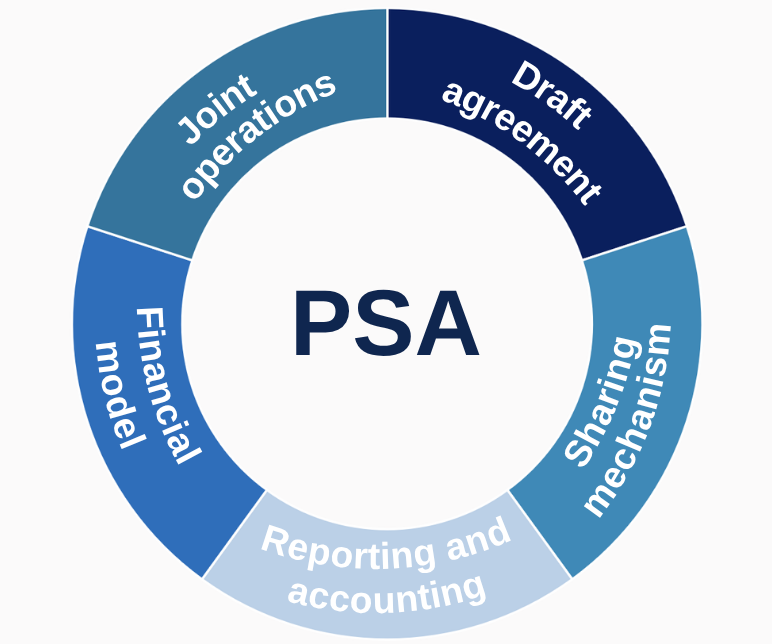
Key components of the work performed
-
Identifying and removing risks in the draft agreement
Provisions capable of creating adverse legal and tax consequences for the investors were identified in the base draft agreement. These risks were worked through and removed from the final version.
-
Revenue-sharing mechanism
A mechanism for sharing production and revenue from hydrocarbon sales between the state and the investors was developed from scratch — taking into account the priority compensation of the investors' development costs (cost recoveryproduction and profit production).
-
Securing access to statutory incentives
The structure of the agreement and accounting was built so that the investors could make full use of the incentives provided by law for PSA participants.
-
Package of reporting templates
A complete package of reporting templates under the PSA regime was developed from scratch — tailored to the specifics of the project and the requirements for interaction with the state.
-
Accounting procedure
An accounting procedure under the PSA was established, reflecting the specifics of the regime (in particular, the accounting of costs subject to compensation to the investors).
-
Working through the agreement between the investors
The draft joint operating agreement (JOA) between the two PSA investors was worked through — the form that governs their joint work on the project.
-
Reconciling the parties' interests
Within the JOA, the investors' roles, rights, costs and responsibilities were delineated — in particular, the status of the operator (the party running the project's operations) was defined.
-
Financial model of the agreement
A financial model was built that substantiates the revenue-sharing mechanism between the state and the investors and confirms the economic balance of the agreement for all parties.
Outcome of the work performed
Results
The outcome of the work was a complete, legally and economically vetted document package for the production sharing agreement — ready to be concluded with the state. The team supported it through all stages up to signing.
Before the team's engagement
-
A standard draft agreement with hidden risks
-
No revenue-sharing mechanism
-
Unregulated relations between the investors
-
No accounting procedure or reporting templates for the PSA


After the work performed
-
A vetted agreement with no legal or tax risks for the investors
-
An economically grounded mechanism for sharing production and revenue
-
An agreement between the investors (JOA) with a clear split of rights, roles, obligations
-
Clear accounting procedure and a complete package of reporting templates for the PSA


